1840s: timeline
1842: The Nation magazine founded by Davis and Duffy [info]
1842: published: Samuel Lover’s Handy Andy
1843: born: Edward Dowden [EB] (d1913) [etexts] more
1845: published: Carleton’s Valentine McClutchy
Young-Ireland poetry keywords: gore, wrath, wrongs, just, true, brave, chains, fight, slave, swords, liberty [WBY essay]; symbols: round tower, wolfhound, harp, shamrock [WBY]; Irish themes with English metres
1845-48: potato famine
1846: born: Standish James O’Grady [poem] (d1915) [Bibliofind]
1846: born: Alfred Perceval Graves [bio] (d1931) [lyrics]
1846: Denis Florence MacCarthy’s Irish Ballads [etext]
1846? MacCarthy’s Poets and Dramatists of Ireland
1847: born: Bram Stoker [info] (d1912)
1850s: timeline
1850: MacCarthy’s Ballads, Poems, and Lyrics [etext]
1852: born: Lady Augusta Gregory [EB] [bio] [info] (d1932) [info] [etext-trans], ditto, ditto, etext theater
1852: born: George Moore [bio&pic] [bio] [bio] [bio] [short bio] (Paris 1873-1880; England 1880-1901, 1911-d1933) [info]
1853: MacCarthy begins translating Calderon
1854: born: Percy French [bio&pic] [bio] [fanpage] (d1922)
1854: born: Oscar Wilde [timeline] [slideshow] [links] ditto (d1900) [etexts]
1855: born: Thomas William Lyster (d1922)
1856: born: George Bernard Shaw [bio] [site] (England 1876-d1950) [etexts]
1856: published: Renan’s Poetry of the Celtic Races [etext]
1857: published: MacCarthy’s Bell-Founder [etext]
1859: founded: Irish Times
1859: published: Meredith’s The Ordeal of Richard Feverel [etext]
1859: born: Edward Martyn [EB] (Catholic, cousin of Moore, d1923)
1860s: timeline
1860: born: Douglas Hyde [EB] [info] [pic] (d1949) [poem] ditto ditto
1860: born: Patrick S Dinneen (d1934) [Bibliofind]
1860: O’Neill Russell’s novel Dick Massey
1861: Eugene O’Curry’s Lectures on the Manuscript Materials of Ancient Irish History
1861: born: Katherine Tynan (d1931) [pic] [etext]
1862: published: Meredith’s Modern Love [etext]
1863: published: Gilchrist’s Life of William Blake [info]
1864: published: Allingham’s Ballad Book
1864: published: Allingham’s Laurence Bloomfield in Ireland
1865: born: Rudyard Kipling [bio] ditto (English, India 1865-71, 1882-89; d1936) [poems]
1865: born: Arthur Symons (Wales) [bio] (d1945)
1865: born: Maud Gonne [EB] (d1953)
1865: born: William Butler Yeats [EB] [bio] [timeline] ditto (England 1874-1880, 1887-96) (d1939)
1866: published: Swinburne’s Poems and Ballads [etext]
1866: born: Susan Mitchell (d1926) [info] ditto
1866: born: Alice Milligan [info] (d1953)
1866: born: Anna Johnston MacManus ‘Ethna Carbery’ [bio] (d1902) [poem]
1867: born: Charles Johnston [Sanskritist who married H. P. Blavatsky’s niece] (d1931) [trans] [etexts]
1867: born: George William Russell (AE) [bio&links] more (d1935) [Bibliofind]
1868: born: William Kirkpatrick Magee (John Eglinton) [bio&links] (Protestant, Theosophist, d1961) [Bibliofind]
1868: born: William J Stanton Pyper [wrote Yeats] (d1941)
1868: born: Daniel Nicol Dunlop [info] [pic] (d1935) [bibliography]
1869: born: Seumus MacManus (d1960) [etext] [etext]
18?? born: Louis H Victory [Bibliofind]
1870s: timeline
1870: Home Rule movement
1871: born: Jack B Yeats [info] (d1957)
1871: published: Swinburne’s Songs Before Sunrise
1871: born: John Millington Synge [EB] [bio], [fansite] ditto (Paris 1893-98) [etexts] (d1909)
1872: born: Richard Irvine Best (d1959) [trans] [Bibliofind]
1872: born: Stephen MacKenna [Latin trans] (d1954)
1872: published: Graves’s Songs of Killarney
1873: born: James H Cousins (d1955) [poem]
1874: born: Ernest Victor Longworth (d1935)
1875: published: Dowden’s Shakspere: A Critical Study of His Mind and Art
1875: Blavatsky founds Theosophical Society in NYC [debunk]
1876: born: Fred Ryan (d1913)
1876: published: Wilde’s first poems ‘From Spring Days to Winter’ [etext], ‘The Dole of the King’s Daughter’ [etext], ‘Rome Unvisited’ [etext], ‘San Miniato’ [etext], ‘By the Arno’ [etext]
1877: published: Meredith’s essay On the Idea of Comedy [etext]
1877: published: HP Blavatsky’s Isis Unveiled [info]
?: born: George Roberts (d1952) [info&pic]
1878: born: Oliver St John Gogarty [links&info] (d1957) [Bibliofind]
1878: born: Thomas MacDonagh (d1916)
1878: Wilde’s poem Ravenna wins Newdigate Prize [etext]
1879: born: James Sullivan Starkey ‘Seumas O’Sullivan’ (d1958)
1879: born: Patrick Henry Pearse [bio] [psych] ditto (d1916) [etexts] 1912 1914 1916
1879: published: Dowden’s Robert Southey
1879: published: Wilde’s Rise of Historical Criticism [etext]
1879: published: Meredith’s The Egoist [etext]
1879: published: Graves’s Irish Songs and Ballads
1879: Ibsen’s A Doll’s House produced in London
1880s: timeline
1880: born: Sean O’Casey [EB] [bio] [etext] (1920s plays) (d1964)
1880: founded: Gaelic Union
1880? written: GB Shaw’s first novel, Immaturity [info]
1880: published: Meredith’s Tragic Comedians
1880: published: Graves’s Irish Songs and Ballads
1880: published: Standish O’Grady’s bardic History of Ireland
1880: published: Wilde’s play Vera [etext]
1881: born: Padraic Colum [bio&pic] [info] (d1972) [etext] ditto [poem]
1881: WBY in High School wants to start natural sciences field club
1881: published: Wilde’s Poems [etext] incl ‘Requiescat’ [etext]
1881: Gilbert & Sullivan parody Wilde in Patience [site]
Popular English novelists around this time: Wilkie Collins [Woman in White 1860] [Moonstone 1868], Conan Doyle [Study in Scarlet 1887] [Stark-Munro 1895], Marie Corelli [Sorrows Of Satan 1897] [info], H Rider Haggard [Solomon 1885], Rhoda Broughton, and Robert Louis Stevenson [etexts]. [more]
Riskier novelists: WH White [1881 info] [crit] sample, Thomas Hardy [Madding Crowd 1874], Kipling, Mary Ward, Israel Zangwill, WT Stead [fan] [sample].
[context: George Moore]
1882: born: James Stephens (d1950) [etext] ditto
1882: Wilde’s US lecture tour [SF review]
1882: Denis Florence MacCarthy’s posthumous Poems [etext]
1882: SL MacGregor Mathers quits Masons and starts Golden Dawn [bio]
1883: Moore’s novel A Modern Lover
1883: Wilde’s play Duchess of Padua [etext]
1883: Lyster translates Dunster’s Life of Goethe
1883: WBY inspired by Shelley to write first serious poetry
1884: Yeats meets George Russell
1884: Moore’s novel A Mummer’s Wife
1884: Hyde graduates Trinity with some Gaelic on him
1884: Lyster helps WBY with Spenserian verse play Island of Statues
1884: Dowden introduces Yeats et al to Sinnett’s Esoteric Buddhism [cite]
WBY hates Manet’s realism: «…no desirable place, no man I could have wished to be, no woman I could have loved, no Golden Age, no lure for secret hope…»
1885: Moore’s nonfiction Literature at Nurse, or Circulating Morals
1885: Wilde’s ‘Harlot’s House’ [etext] and ‘Truth of Masks’ [etext]
1885: Feb: Dublin University Review founded by Oldham and Rolleston
1885: Mar: Yeats’s first poems in Dublin University Review
1885: 16 June (!): Yeats, Russell, and Chas Johnston found Dublin Hermetic Society
1885: John O’Leary recognises WBY’s genius, awakens his nationalism
1885: Oct: Yeats joins Young Ireland Society (takes Fenian oath?)
1885: 21 Nov: Contemporary Club founded (incl Hyde, JBY, Sigerson, AE, JF Taylor, Davitt, Rolleston, O’Leary, Maud Gonne)
Dowden on Yeats: «He hangs in the balance between genius and (to speak rudely) fool.» [cite]
John B Yeats on Dowden: «would not trust his nature»
WBY on DHS: «A little body of young men hired a room in York Street… and began to read papers to one another on the Vedas, and the Upanishads, and the Neoplatonists, and on modern mystics and spiritualists. They had no scholarship, and they spoke and wrote badly, but they discussed great problems ardently and simply and unconventionally as men, perhaps, discussed great problems in the medieval universities.»
1886: born: Lennox Robinson [EB] (1916-18 plays) (d1958)
1886: Yeats’s verse play Mosada
1886: Synge joins Dublin Naturalist’s Field Club, reads Darwin
1886: Dublin Lodge of Theosophical Society founded
1886: Dowden’s Life of Shelley
1886: Moore’s novel A Drama in Muslin [info]
1886: Dec: Yeats’ poem «The Stolen Child»
Tynan on WBY: «beautiful to look at, with his dark face, its touch of vivid colouring, the night-black hair, the eager dark eyes»
WBY: «I hate reasonable people… The only buisness [sic, dyslexic] of the head in the world is to bow ceaseless obeisance to the heart.»
1887: Yeats meets Mme Blavatsky [cite] [cf Johnston]
1887: Lady Wilde’s Ancient Legends, Mystic Charms, and Superstitions of Ireland
1887: Moore’s nonfiction Parnell and His Island
1887: Moore’s A Mere Accident
1887: born: Joseph Mary Plunkett [site] (d1916)
1887: Freeman’s Journal makes ‘Synge’ (brother) an alias for cruel landlords [cite]
1888: Yeats joins Esoteric Section of the Theosophical Society
1888: Yeats’s Fairy and Folk Tales of the Irish Peasantry
1888: Sept: first version of WBY’s poem «Salley Gardens»
1888: Mar: Pan-Celtic Society founded by Yeats’s circle
1888: Moore’s novel Confessions of a Young Man
1888: Moore’s Spring Days
1888: Wilde’s tales The Happy Prince [etext]
1888: MacGregor Mathers’s Qabbalah Unveiled
1888: Blavatsky’s The Secret Doctrine
1888: Joyce to Clongowes
1888: 14 Jan: Telegraph parodies Yeats’s circle:
«They will tell you that he is too exquisite and ethereal to be understood or appreciated by the common British reviewer and hence his obscurity… [WBY] invites you to believe by the ingratiating sweetness with which he takes his spoiling»
1889: Graves’s lyrics Father O’Flynn
1889: O’Grady’s Red Hugh’s Captivity
1889? Yeats shaves beard (‘decadent’ style?) [pix]
1889: WBY begins deep study of Blake’s prophetic works
1889: Yeats’s poems Crossways [etext]
1889: Yeats’s The Wanderings of Oisin [etext]; meets Maud Gonne
1889: Moore’s novel Mike Fletcher
1889: Amye Reade’s Ruby [cite]
1889: Wilde’s dialog ‘Decay of Lying’ [etext]
1889: Wilde’s ‘Portrait of Mr WH’ [etext]
1890s: timeline
1890: Hyde’s Beside the Fire: Irish folktales
1890: Curtin’s Myths and Folk Lore of Ireland [etext]
1890: Lady Wilde’s Ancient Cures, Charms, and Usages of Ireland
1890: Oscar Wilde’s novel Picture of Dorian Gray [etext]
1890: Wilde’s dialog Critic as Artist [etext]
1890: Wilde’s nonfiction Soul of Man Under Socialism [etext]
1890: Yeats and Rhys found the Rhymers Club in London, with Lionel Johnson, Ernest Dowson, and Arthur Symons
1890: Yeats joins Hermetic Order of the Golden Dawn [info]
1890: Gandhi meets Mme Blavatsky in London, reawakening his interest in Hinduism [cite]
1890: Villiers de l’Isle-Adam’s play Axel (Paris) «the swan song of romanticism» [info] more [poems]
1891: Lady Wilde’s Notes on Men, Women and Books
1891: Oscar Wilde’s stories Lord Arthur Savile’s Crime [etext]
1891: Shaw’s Quintessence of Ibsenism [extract]
1891: Moore’s nonfiction Impressions and Opinions
1891: Moore’s novel Vain Fortune
1891: Maud Gonne joins Golden Dawn
1891: death of Parnell (6 Oct)
Yeats on Ireland post-1891:
«Nationalist Ireland was torn with every kind of passion and prejudice, wanting so far as it wanted any literature at all, Nationalist propaganda disguised as literature. All the past had been turned into a melodrama with Ireland the blameless hero…» [cite]
Yeats: «a tall, dark-visaged young man who walked the streets of Dublin and London in a poetic hat, cloak, and flowing tie, intoning verses» [cite]
O’Leary to WBY: «In this country a man must have upon his side the Church or the Fenians, and you will never have the Church.»
Golden Dawn members included: Yeats, Maud Gonne, Annie Horniman, Arthur Machen [etext] and Arthur Waite timeline [pix]
1892: death of Lady Gregory’s husband, Sir William Henry Gregory
1892: founded: Irish Literary Society
1892: Hyde’s lecture ‘On the Necessity of De-Anglicising the Irish People’
1892-97: Dunlop editor of The Irish Theosophist [cite]
1892: Yeats’s play The Countess Kathleen
1892: Wilde’s play Lady Windermere’s Fan [etext]
1892: published: Emily Lawless’s Grania [etext]
1892: Dowden’s Poetical Works of William Wordsworth
1892: Kipling’s Barrack-room Ballads [Mandalay] [Long Trail] [full etext]
1893: Lyster edits English Poems for Young Students
1893: Dunlop’s Protean Man (Theosophy)
1893: O’Grady’s The Bog of Stars
1893: Larminie’s West Irish Folk-Tales and Romance
1893: Wilde’s plays Salomé [etext] and A Woman of No Importance [etext]
1893: Moore’s nonfiction Modern Painting
1893: Moore’s play The Strike at Arlingford
1893: Yeats’s ‘Lake Isle of Innisfree’ [RealAudio]
1893: Yeats’s poems The Rose [etext]
1893: Yeats’s The Celtic Twilight
1893: Douglas Hyde founds Gaelic League [overview] [history]
«Michael Collins viewed the founding of the Gaelic League in 1893 as the ‘greatest event’ not only of the century, but of ‘the whole history of the nation’ for it ‘did more than any other movement to restore the national pride, honour, and self-respect.'» [cite]
1894: Joyce at Belvedere uses Lyster’s poetry anthology
1894: Yeats’s play The Land of Heart’s Desire
1894: Russell’s poems Homeward sample ditto ditto
1894: Moore’s novel Esther Waters
1894: Somerville and Ross’s novel The Real Charlotte
1894: WT Stead’s genre-defining review ‘The Novel of the Modern Woman’ [info]
1894: Wilde’s The Sphinx [etext]
1894: Shaw’s play Arms and the Man [background]
1894: Hyde’s The Story of Early Gaelic Literature
Yeats impresses Moore (in London) [cite], meets Wilde, William Morris
Edward Martyn to George Moore: «I wish I knew enough Irish to write my plays in Irish» Moore: «I thought nobody did anything in Irish but bring turf from the bog and say prayers.» [cite]
1895: Wilde’s plays An Ideal Husband [etext] and Importance of Being Earnest [etext]
1895: Yeats’s Poems
1895: Dowden’s New Studies in Literature
1895: O’Grady’s The Chain of Gold
1895: Moore’s criticism The Royal Academy 1895
1895: Moore’s short stories Celibates
1895: Hyde’s Love Songs of Connacht (‘gapped music’) [info] sample
1895: trial and imprisonment of Oscar Wilde [info]
1896: Louis H Victory’s Higher Teaching of Shakespeare [cite]
1896: Dowden’s Transcripts and Studies
1896: Wm Sharp’s Lyra Celtica [etext]
1896: O’Grady’s Ulrick the Ready
1896-99: Milligan and Carberry found Shan Van Vocht [info]
1896: Yeats visits Paris, urges Synge to write about Ireland [info]
1896: Yeats meets Lady Gregory
1897: Yeats spends summer at Lady Gregory’s estate Coole
1897: Yeats experiments with hashish and mescaline
1897: Yeats’s The Adoration of the Magi (admired by JAJ)
1897: Yeats’s The Secret Rose
1897: Yeats’s The Tables of the Law (admired by JAJ)
1897: Russell leaves drapery store to organise agricultural cooperatives for Irish Agricultural Organisation Society (IAOS)
1897: Graves’s Irish Folk Songs
1897: Sigerson’s Bards of the Gael and Gall
1897: Bram Stoker’s Dracula [etext], Ethel Voynich’s The Gadfly
1897: Kipling’s poem ‘Recessional’
1897: Dowden’s A History of French Literature
1897? Dowden’s The French Revolution and English Literature
1897? Irish Homestead founded by the IAOS [date]
«…a little weekly paper, the Irish Homestead, acts as the organ of the movement, promotes the exchange of ideas between societies scattered throughout the country, furnishes useful information upon all matters connected with their business operations, and keeps constantly before the associated farmers the economic principles which must be observed, and, above all, the spirit in which the work must be approached, if the movement is to fulfil its mission… Those wishing to keep au courant with the further development of the movement would do well to take in the Irish Homestead, post free 6s. 6d. per annum.» [cite]
1898: Moore’s novel Evelyn Innes flatters WBY as ‘Ulick Deane’
1898: Wilde’s Ballad of Reading Gaol [etext]
1898: Aleister Crowley drops out of Cambridge, joins Golden Dawn, rises quickly to prominence [bio]
1898: debate about national drama in Daily Express [info]
1898: ‘spiritual marriage’ between Yeats and Maud Gonne
1898: Irish Literary Theatre established by Yeats, Gregory, and Martyn [history]
«Ireland is not the home of buffoonery and of easy sentiment, as it had been represented, but the home of ancient idealism.» [more]
Lady Gregory’s charming memoir
1899: Yeats’s Countess Cathleen and Martyn’s Heather Field and Maeve performed
1899: Hyde’s A Literary History of Ireland
1899: Kipling’s poem ‘The Absent-minded Beggar’ set to music by Arthur Sullivan [lyrics&midi]
1899: Symons’s The Symbolist Movement in Literature
1899: Synge summers on Aran Islands
1899: Yeats’s poems The Wind among the Reeds [etext] [info]
Yeats on Trinity College: «…turned our once intelligent gentry into readers of The Irish Times.» (The Irish Times, with a circulation of about 45,000, vied with the pro-home-rule Freeman’s Journal and Evening Telegraph, with circulations of about 40,000 and 26,000, respectively. Conservative papers such as the Daily Express [edited by Longworth, bought reviews from JAJ in 1903] and Evening Herald had small but respectable circulations, as had the broadly non-partisan Daily Independent and Evening Mail.) [cite]
1900s: timeline [Irish Times] more
1900: Moore rewrites Martyn’s play Tale of a Town as Bending of the Bough [history]
1900: ILT performs The Bending of the Bough, Maeve, and The Last Feast of the Fianna by Alice Milligan
1900: Fortnightly Review publishes 17yo Joyce’s Ibsen review
1900: Joyce attends Pearse’s Gaelic classes
1900: Archer scorns Joyce’s play A Brilliant Career
1900: Dowden’s Puritan and Anglican: studies in literature
1900: Yeats’s play The Shadowy Waters [etext]
1900: death of Oscar Wilde
«Crowley’s behavior… was too outrageous for most of the London members, who disapproved of his blatant sexual activities. In January of 1900, the Isis-Urania Temple refused to obey an instruction from Mathers to initiate Crowley into the second order, the RR et AC. Mathers was livid. He invited Crowley to Paris and initiated him in that city. The Golden Dawn officers in London rebelled. Mathers threatened to smite the insurgents with a Punitive Current generated by the Hidden and Secret Chiefs. Then he dispatched… Crowley to suppress the rebellion. In the ‘Battle of Blythe Road’, Crowley was ejected by a constable after he broke into the Order’s London quarters (located at 36 Blyth Road). On April 19, Crowley reappeared in Blyth Road…He was clad in a Highland dress, wearing a black mask of Osiris [pix] over his face, and carried a dagger. The rebels got rid of him by again calling the police. Crowley returned to Paris…» [more]Yeats faction: «We did not think a mystical society was intended to be a reformatory» [cite]
Crowley on WBY: «a lank dishevelled demonologist»
Yeats style shifts from esthete to folk
1901: Moore moves back from London to Dublin, blaming Boer War cruelty
1901: Moore’s novel Sister Theresa
1901: Graves’s Songs of Erin
1901: Eglinton’s essays: Pebbles from a Brook
1901: Yeats at Coole [memoir]
1901: Oct: Joyce’s «Day of the Rabblement» disses WBY, Moore, and Martyn (Moore’s take: «preposterously clever»)
1901: Yeats and Moore’s play Diarmuid and Grania
1901: Hyde’s Gaelic play, The Twisting of the Rope (Casadh an t-Sugain)
Moore’s literary associates were Russell, Martyn, Yeats, Eglinton (aka ‘Little John’), Douglas Hyde, Lady Gregory, John (Jack?) Butler Yeats, Nathaniel Hone[painter], John Pentland Mahaffy (provost of Trinity, knighted 1918), Walter Osborne [painter], John Hughes (d1941? ??? 1870-1918?) [cite]
Yeats on Moore («more mob than man… quite untrustworthy… old lecher») and Martyn («holy man… woman-hater») [quote] more
Joyce to his brother: «Ireland has contributed nothing but a whine to the literature of Europe» [mbk162, ie patriotic songs]
1902: Moore splits with Yeats (?), ILT dissolved
1902: Yeats and Lady Gregory found Irish National Theatre Society [Abbey]
1902: Yeats and Lady Gregory collaborate on Cathleen ni Houlihan [background] [summary] [info] debate [lyric]
1902: Martyn founds Palestrina Choir [info]
1902: Yeats sisters form Dun Emer Press [Bibliofind]
1902: Jack B Yeats edits Broadsheet
1902: WB Yeats’s play The Pot of Broth
1902: Russell’s play Deirdre
1902: Dowden’s Studies in Literature 1789-1877
1902: Dinneen’s Irish Prose
1902: Shaw’s play Man and Superman [etext]
1902: An T-Ur-Gort (Gaelic translation of Moore’s ‘Untilled Field’ stories)
1902: Seumas O’Cuisin’s plays The Sleep of the King and The Racing Lug
1902: Fred Ryan’s play The Laying of the Foundations
Lady Gregory makes continuous narratives out of Irish sagas, translating them into an Anglo-Irish peasant dialect she calls «Kiltartan.» [1919] Published asCuchulain of Muirthemne (1902) [etext] and Gods and Fighting Men (1904). The former includes an intro by WBY discussing dramatic, lyrical, epical, and romantic temperaments. [etext]
Martyn splits with Irish Revivalism because of dislike of «peasant plays» and «Celtic twilight romanticism.»
1902: August: Joyce introduces himself to Russell, asks about Irish avatar, reads his poems
1902: Oct: Joyce introduces himself to Yeats (just back from London), and to Lady Gregory
1902: Dec: Joyce reviews Jerrold’s George Meredith
JAJ on Meredith: «occasional power of direct compelling speech… lacking the lyrical impulse… no value as epical art… a philosopher at work with much cheerfulness upon a very stubborn problem»
1902-3: Joyce in Paris, meets Synge, Symons; meets Gogarty and Eglinton over Xmas back in Dublin
AE on JAJ: ‘asked about planes of consciousness’, «not enough chaos in you to make a world», «extremely clever» «first spectre of the new generation» ‘critising bad taste of his deity’ ‘poems delicate and dainty as Watteau’
WBY on JAJ: «colossal self-conceit… Lilliputian literary genius» «wrote excellently but had the worst manners» ‘best technique of the young Dublin crowd’
Moore on JAJ: «a beggar»
JAJ on WBY: «floating will» ‘gone over to the rabblement’, patronizing in Irish enthusiasm, «too old for me to help you» (contested); ‘inspiration fading, replaced by general ideas, folklore, politics’
WBY on his own reputation: «a preacher of reckless opinions and a disturber who carries in his hand the irresponsible torch of vain youth». WBY on AE: «leads an even more reckless rebellion»
JAJ on Theosophists: disaffected Protestants
JAJ to WBY on Wilde: JAJ hoped his deathbed conversion had not been sincere (ie, untrue to self)
In London, Golden Dawn splits between Waite (mysticism) and Yeats and Robert Felkin (magic). Yeats’s faction was called the Stella Matutina, or Morning Star[cite] [FAQ]
Russell, Maud Gonne and several others leave INTS from political objections (Yeats wanted it poetic not political); INTS gains Synge, actress Sara Allgood, and patroness Anne Horniman (who demands there be no political slant to their work) [history] [Russell- 1902?]
1903: Hyde’s Songs Ascribed to Raftery
1903: Synge’s In the Shadow of the Glen [etext]
1903: Lady Gregory’s play Twenty-Five
1903: Yeats’s plays The Hour Glass and The King’s Threshold
1903: Yeats’s poems In the Seven Woods [etext]
1903: Yeats’s poems «The Old Age of Queen Maeve» [etext] and «Baile and Aillinn» [etext]
1903: Yeats’s Ideas of Good and Evil (w/o preface about J’s visit)
1903: Gregory’s Poets and Dreamers
JAJ review of Gregory: «…stories about giants and witches, and dogs and black-handled knives… none has any satisfying imaginative wholeness… sets forth [the ‘folk’ mind] in the fulness of its senility…»
1903: May: INTS performs successfully in London
1903: Sept: Joyce applies to Dowden for job («quite unsuitable»)
1903: Nov: Yeats’s US lecture tour
1903: Joyce reviewing books in Daily Express (until Longworth threatens to kick him downstairs)
1903: Moore’s short stories The Untilled Field
1903: Best translates Jubainville’s The Irish Mythological Cycle
1903: Best co-founds School of Irish Learning
1903: Pearse editor of Gaelic League’s An Claidheamh Soluis
1903: Victory’s Imaginations in the Dust
1903: Samuel Butler’s Way of All Flesh [etext]
1903: Joyce tries (w/Skeffington) to start newspaper, The Goblin
1903: Joyce sub-editor of «Irish Bee-keeper» for a day
1903: Colum’s play Broken Soil
1904: Seumas McManus’s play The Townland of Tamney
1904: Dana founded; Joyce’s autobiographical essay rejected [etext]
1904: Feb: Joyce starts Stephen Hero
1904: Synge’s Riders to the Sea [etext]
1904: Dowden’s Robert Browning
1904: Dinneen’s Irish-English Dictionary
1904: Yeats’s play On Baile’s Strand
1904: Yeats’s play The King’s Threshold
1904: April: Crowley’s visions in Egypt
1904: April: Anne Horniman offers Abbey site [info] to Theatre Society
1904: May? Russell edits New Songs with poems by Colum, Milligan, Mitchell, O’Sullivan, Roberts, Eva Gore-Booth, Thomas Koehler, Ella Young
1904: July: AE invites JAJ to write stories for «Irish Homestead»
1904: Aug: Joyce attacks Irish lit in «The Holy Office» [etext]
Joyce’s place in Irish lit [essay] His reading [calendar]
1905: Eglinton’s Some Essays and Passages (selected by Yeats)
1911-14: Moore’s autobiography Hail and Farewell
1912: Joyce takes a few more shots in ‘Gas from a Burner’ [etext]
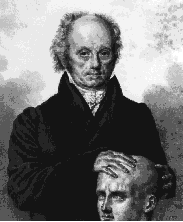 The real scientific Phrenology, which established a direct link between the morphology of the skull and the human character, was discovered by the Austrian physician Franz Joseph GALL (1758-1828). Gall put the foundations for an anatomic caracteriology. He was one of the first to consider the brain as the home of all mental activities.
 Other important authors on the subject in the last century include the Scottish brothers George COMBE(1788-1858) and Andrew COMBE (1797-1847). George Combe was the author of some of the most popular works on Phrenology and the hygiene of the mind, like The Consitution of Man or Elements of Phrenology. The picture right shows a daguerrotype of George Combe. (Thanks to Miguel Angel Cuarterolo from Argentina for this image).
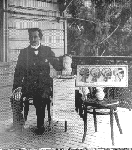 In the early 19th century, Phrenology gained a rapidly growing interest. Some scrupless people did however abuse the science for commercial purposes, and the Victorian period saw the emergence of Phrenological parlours which were closer to astrology, chiromancy, and the like, than to real scientific characterology. Unfortunately, those con-men have done a lot to stain the image of Phrenology as a real science, and their bad influence lives up to today.